9mm vs .45 ACP: Which Caliber Is Better for Self-Defense?
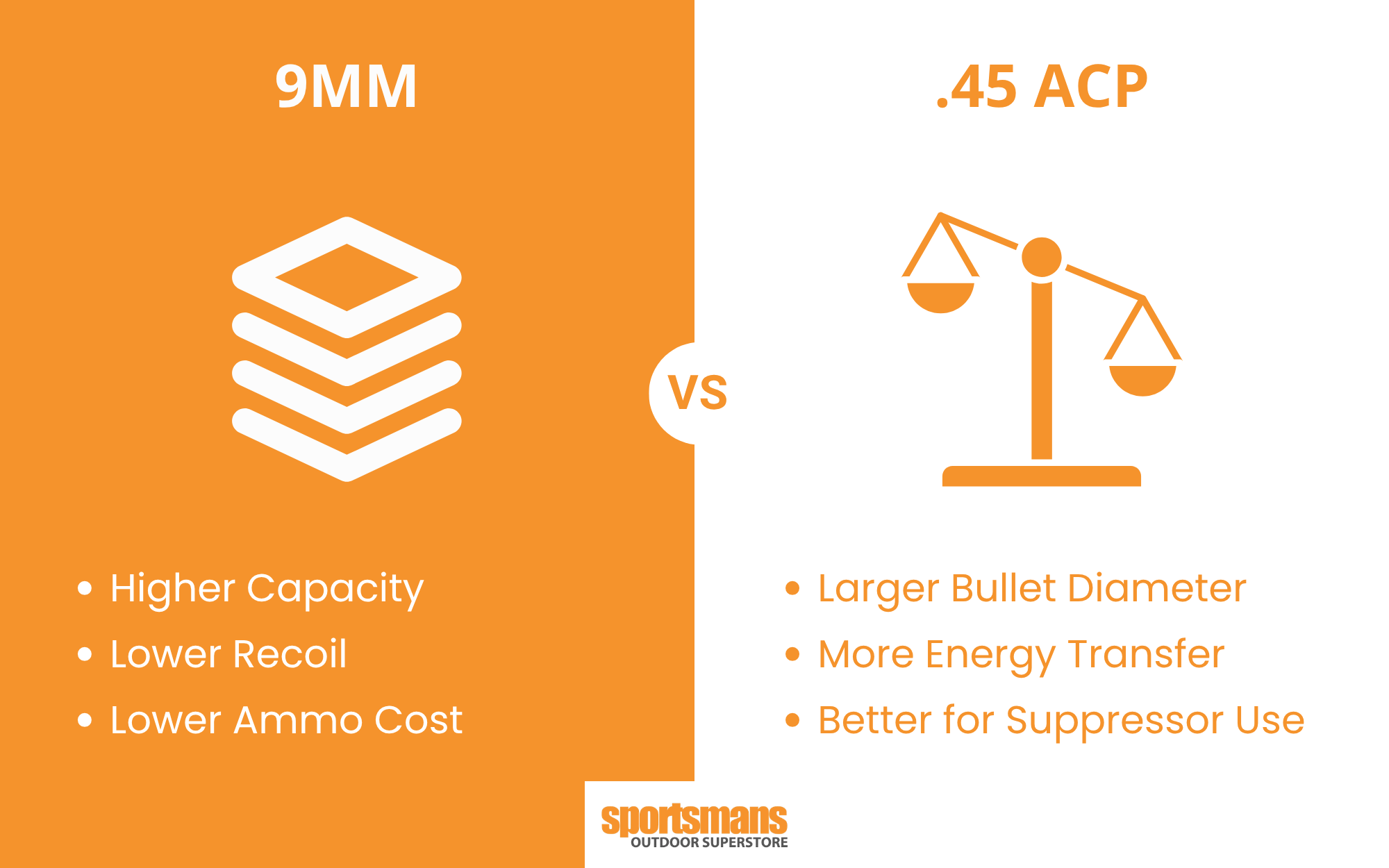
The Short Answer: The 9mm and .45 ACP are both self-defense cartridges with a century of proven performance. The 9mm offers higher magazine capacity, lower recoil, and lower ammo cost. The .45 ACP delivers a larger diameter bullet with more energy transfer per round. For most civilian shooters, the 9mm is the more practical choice, but the right answer depends on your intended use, your pistol, and what you shoot most accurately.
Few debates in the firearms world spark as much discussion as 9mm vs .45 ACP. Both cartridges have been carried by law enforcement and trusted by homeowners for decades. The .45 ACP has a reputation for stopping power, while the 9mm is known for capacity and control.
A Brief History of Both Cartridges
The 9mm
The 9mm Luger was developed by German firearms designer Georg Luger in 1902, originally designed for use in his Luger semi-automatic pistol. It gained traction quickly with military and law enforcement agencies across Europe and eventually became the standard sidearm cartridge for NATO countries and law enforcement agencies across the United States. Its combination of manageable recoil, higher capacity, and wide availability made it the dominant pistol caliber in the world.
The .45 ACP (Automatic Colt Pistol)
The .45 ACP was designed by John Browning in 1904 for use in his prototype Colt semi-automatic pistol. It became the standard U.S. military sidearm with the M1911 and remained in that role for over 70 years. The .45 ACP built its reputation on a larger diameter bullet and strong energy transfer at close range. It remains popular with competitive shooters and those who prefer a steel frame pistol for home defense.
Cartridge Specs Compared
Per SAAMI's published standards, the two cartridges differ significantly in pressure, diameter, and dimensions. The biggest takeaway from the numbers is capacity. The 9mm holds significantly more rounds than the .45 ACP in a comparable frame, while the .45 ACP's larger bullet diameter gives it a wider wound channel on impact.
| Spec | 9mm Luger | .45 ACP |
|---|---|---|
| Bullet Diameter | 0.355 in | 0.452 in |
| Case Length | 0.754 in | 0.898 in |
| Overall Length | 1.169 in | 1.275 in |
| Max Pressure (SAAMI) | 35,000 psi | 21,000 psi |
| Muzzle Velocity (typical) | 1,100-1,200 fps | 830-950 fps |
| Muzzle Energy (typical) | 350-450 ft-lbs | 350-500 ft-lbs |
| Typical Magazine Capacity | 15-17 rounds | 8-13 rounds |
Key Performance Differences
Recoil and Controllability
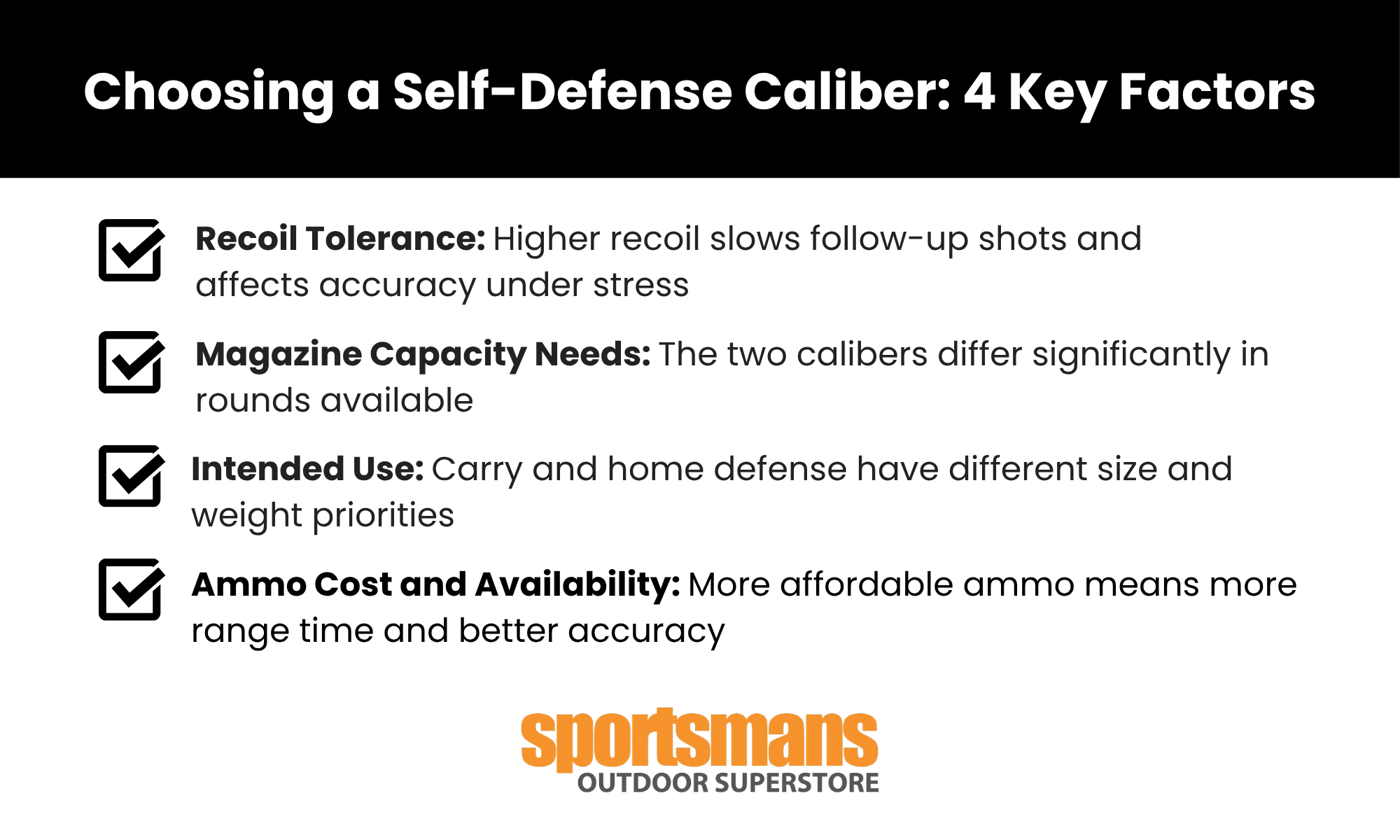
The 9mm generates roughly half the felt recoil of the .45 ACP. It fires a lighter bullet at higher velocity, while the .45 ACP pushes a heavier bullet at lower velocity. That heavier bullet and added powder charge translate to more felt recoil and muzzle rise between shots. In a self-defense situation, low recoil translates directly to faster and more accurate follow-up shots.
It is worth noting that a steel frame .45 ACP pistol absorbs significantly more recoil than a polymer frame, which is why many 1911 owners find the .45 ACP shoots softer than expected.
Stopping Power and Terminal Performance
The .45 ACP's larger diameter bullet creates a wider permanent wound channel. A 9mm hollow point typically expands to roughly 0.6 inches on impact, while a .45 ACP hollow point can expand to nearly 1 inch. That said, modern defensive loads have dramatically improved 9mm terminal performance.
The FBI's wound ballistics research evaluates penetration through ballistic gelatin and various barriers, and modern 9mm hollow points consistently meet those benchmarks. Those results contributed to the FBI's decision to adopt the 9mm for their agents in 2015, pointing to improved defensive ammo alongside the capacity and recoil advantages.
Ammo Cost and Availability
9mm ammunition typically costs around half as much per round as comparable .45 ACP ammo. Both calibers are widely available, but 9mm has a broader selection at every price point. More affordable ammo means more range time, which builds the accuracy and confidence that matter most in a self-defense situation.
Which Caliber Is Better for Self-Defense?
Home Defense
For home defense, both calibers are effective when loaded with quality hollow points. The .45 ACP's lower velocity and heavier bullet reduce over-penetration risk through interior walls, which is a real consideration in a residential setting. A 9mm loaded with modern defensive ammo performs reliably as well and gives you more rounds before a reload, a distinct advantage if the situation requires it.
Concealed Carry
The 9mm has a clear practical advantage for concealed carry. Pistols chambered in 9mm tend to be smaller, lighter, and carry more rounds than .45 ACP alternatives. A double-stack 9mm carry gun typically holds 15 rounds in a frame that is often thinner and lighter than a comparable .45 ACP pistol. The added weight of most .45 ACP platforms makes it a harder choice for all-day comfort, though personal preference plays a role and some shooters make it work.
What the FBI Data Says
The NSSF emphasizes that the best defensive firearm is one you can operate accurately under stress. The FBI's 2015 ammunition study supports that directly. Their research found that modern 9mm hollow points produce terminal performance comparable to larger calibers, while offering higher capacity, lower recoil, and reduced cost. The bottom line: shot placement and ammunition quality matter more than caliber in most real-world self-defense situations.
Sportsman's Outdoor Superstore: Your Source for 9mm and .45 ACP
Sportsman's Outdoor Superstore carries a wide selection of pistols chambered in both 9mm and .45 ACP, along with defensive ammo, range ammo, and accessories for both calibers. Backed by 87 years of firearms expertise through the Vance family, our focus is on keeping popular calibers in stock and getting your order delivered quickly.
Browse our full selection of semi-auto handguns, 9mm ammo, and .45 ACP ammo and find what you need in one place.
Frequently Asked Questions
Is 9mm or .45 ACP better for self-defense?
Both are proven self-defense calibers. Modern 9mm defensive loads have closed the performance gap with .45 ACP significantly. The 9mm's higher capacity, lower recoil, and lower ammo cost give it a practical edge for most shooters, while the .45 ACP's larger bullet diameter remains a genuine advantage for those who prefer it.
Does .45 ACP have more stopping power than 9mm?
The .45 ACP fires a larger diameter bullet that creates a wider wound channel on impact. Modern 9mm defensive loads have improved significantly, and the FBI considers both calibers effective. Shot placement matters more than caliber in most real-world situations.
Which caliber has higher magazine capacity?
The 9mm has a clear capacity advantage. A standard double stack 9mm pistol holds 15-17 rounds compared to 8-13 rounds for a comparable .45 ACP pistol. For shooters who prioritize rounds available, the 9mm wins.
Is .45 ACP better for home defense?
The .45 ACP's lower velocity and heavier bullet reduce over-penetration risk through interior walls, which matters in a home defense scenario. Both calibers work well when loaded with quality hollow points. What you shoot most accurately should guide your choice.